
A few weeks ago, I was sitting with Jill Matthiasson alongside her vineyards in Napa on a warm summer afternoon, sipping on a glass of Schioppettino and talking about how the warm weather was affecting her grapes. She mentioned to me that climate change was making everything more difficult and that a number of (very) prestigious producers were talking about restoring their vines to the Pergolet or bush vine system. After the summer heatwave that Europe just experienced (including the earliest harvest in Burgundy in over 500 years), it’s not hard to imagine.
Unlike the predominate Guyot method that involves trellising canes to optimize grape production, the bush vine system (how the Greeks used to do it) is better-suited for an increasingly warmer climate because it requires less water and provides a natural canopy to protect the grapes from sun exposure. In a vintage like 2026 where temperatures spiked to extraordinary levels, water and shade are paramount to retaining freshness and acidity. To restore Europe’s oldest and most iconic vineyards to a style of farming not practiced in centuries would be no small task, but it may be necessary moving forward.
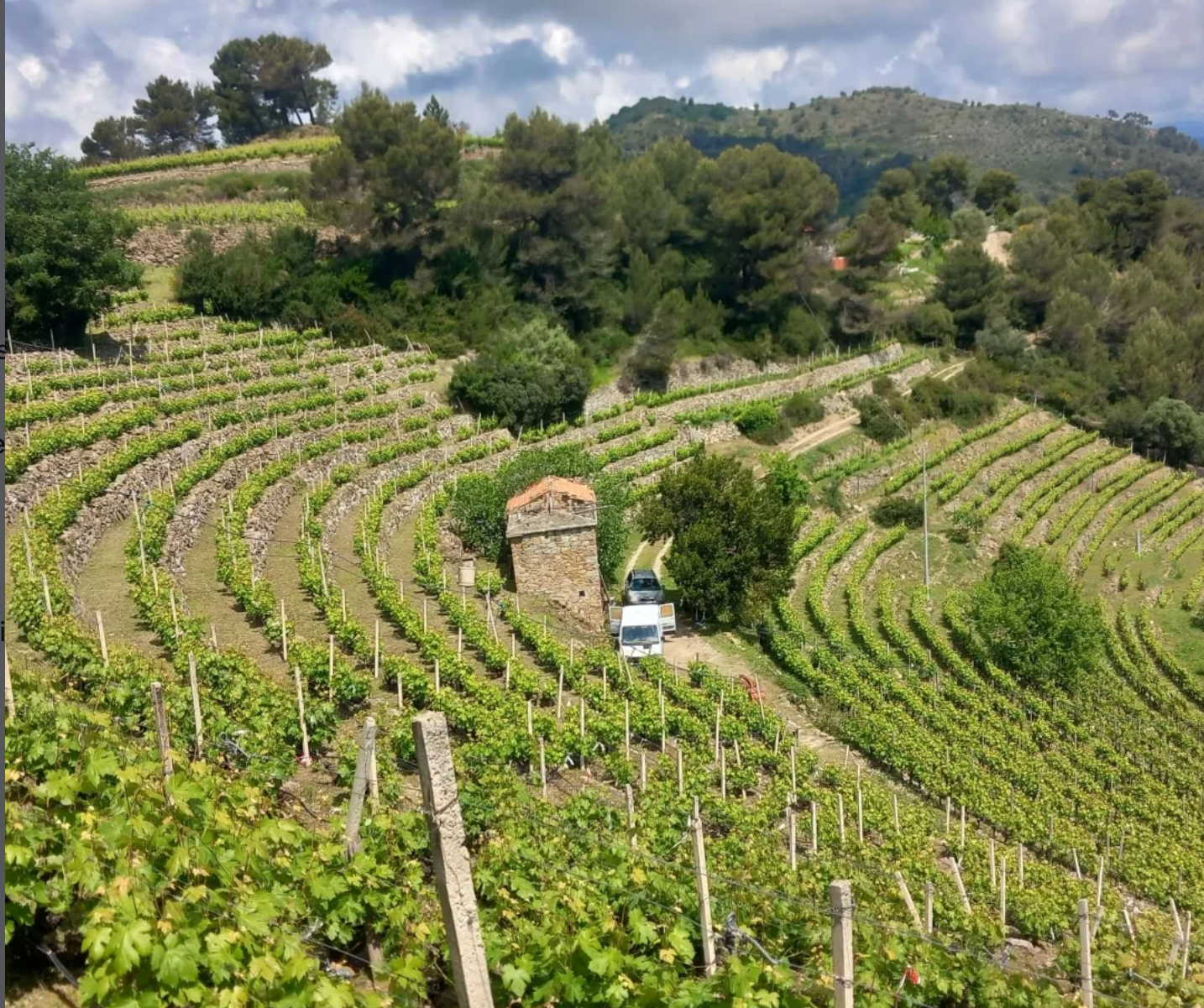
In certain corners of Italy, the bush vine never went out of style. The region of Liguria near the French border, just up the coast from Monaco, houses the tiny Rossese di Dolceacqua DOC where one producer is still tending its vines the old fashioned way. Ka Mancinè, run by Maurizio Anfosso and Roberta Repaci, farms three hectares of very old vines planted into a terraced, stone wall amphitheater. Used throughout ancient Greece to retain moisture and create a highly-efficient microclimate, the shape of the vineyard helps to retain water and prevent evaporation, while the shape of the bush preserves humidity in both the grape and the vine.
Ka Mancinè’s old vines are split into two separate sites: Beragna and Galeae. When I say “old vines,” I mean it. Beragna vineyard was planted on its own roots back in 1872 on a very steep south-east facing slope. Original, pre-phylloxera roots are extremely rare outside of Southern Italy, as are 150+ year old vines. Clearly, they have stood the test of time for a reason, and that durability is exactly the reason why some of the most prestigious names in the wine world right now are considering a return to the bush vine. The other reason is a change in fashion as it regards to demand.
The New York Times recently ran an article about how Bordeaux has become so unpopular that even people who live in Bordeaux aren’t drinking it. Napa winemakers are laying off employees and ripping out vines. Opulent, full-bodied wines are no longer desired by younger generations who prioritize acidity and purity of fruit above all else. The wines from Ka Mancinè are also the archetype of what’s trending in the low-intervention world at the moment. Made from 100% Rossese, they are pale in color, fresh on the palate, with a vibrant juiciness that clocks in right around 12-13.5% ABV. Food friendly and utterly drinkable, they are able to remain lower in alcohol during warm vintages because of the way they farm.
Rossese is actually the same grape as the French Tibouren, perhaps most well-known in the famous Provencial rosé from Clos Cibonne just across the border—another star in the organic, low-intervention world that also uses the bush vine system in its vineyards. While the Guyot trellis systems have helped to maximize mechanization in the vineyard, they expose grapes to intense direct sunlight, which accelerates evaporation. Having just returned from harvesting in Europe, I’ve seen the impact of the recent heat firsthand. Growers using the Gobelet method have thus far been able to better manage water stress and ripeness, and Ka Mancinè is a perfect example of how the old ways of farming are becoming more relevant than ever. The wines are vibrant, fresh, and likely to inspire confidence in a return to the bush vine.
-David Driscoll